


















Telephony University

Telephony University

Join us for an in-depth day on Deep Packet Inspection. Telephony University presents three Webcasts and an interactive panel of experts to explore all things DPI. You’ll hear from the industry professionals leading the way and participate in Q+A with our experts.

Learn more
         Subscribe in NewsGator Online   Subscribe in Bloglines     

NAB: Mobile TV’s Three ‘Megatrends’

more on the topic

More Related Articles

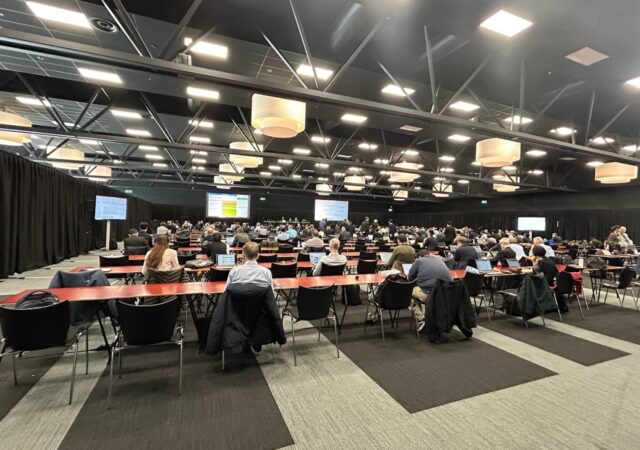
LAS VEGAS – Among an array of standards for mobile television, the FLO Forum had a presence at the NAB show this week promoting Forward-Link Only (FLO) as the standard of choice to expedite the mobile TV market. The body of more than 90 wireless companies added Media Excel to its roster and announced that its Open Conditional Access (CA) framework would be in use by Irdeta, Nagravision and NDS to integrate their solutions with MediaFLO. As the mobile TV market continues to attract a lot of attention at the conference, Kamil Grajski, vice president of engineering for Qualcomm and president of FLO Forum, spoke with Associate News Editor Sarah Reedy about what the FLO Forum sees as the three biggest trends in mobile TV today.

On the multistandard mobile TV world: In the mobile broadcast space, it’s a fact of life that the world has a multiplicity of published standards and commercially launched mobile TV standards. You might think that it is an impossible situation; that there should be efforts to eliminate some technologies by mandate, but the industry has embraced or responded to multiple standards by adopting multimodal product strategies. Qualcomm has chips that do three standards.

Purely from the manufacturing side, the drive for multimodal chips comes from a desire to have more efficient manufacturing and supply chains. You don’t get economies of scale by declaring one technology the standard for the region…Do one design once with the guts the same but the skins different for a global hardware platform approach. You don’t want to have three different versions of the platform – just one chip.

People need economies of scale because one technology is exclusive to a region. Because it’s a global market, you can get economies of scale through efficient manufacturing of multimodal products. It is the next generation of economies of scale.

The global market place is hugely complicated, and it’s no longer the case that any single company can bring dramatically new technology to the market alone. It is all about creating ecosystems and published, open standards.

We are each absolutely dedicated to the success of mobile TV and broadcast. FLO represents the next generation of mobile TV technologies. These others are all adaptations that have to be backwards-compatible with existing standards. It’s like going into a fight with one hand tied behind your back. Technologies like FLO were designed for mobility from the get-go. That doesn’t mean that one is better or worse. You have to adapt the technology to your business.

On the ‘digital dividend’: [The digital dividend] refers to the spectrum that is made available once the analog broadcasters shift to digital. They needed this much spectrum to deliver all the content you see on broadcast today, but now they need [less]. What do you do with all the leftover spectrum? In the US, we are quite far along in this transition away from analog to digital. That process of deciding what to do with the extra spectrum started in the late 80s. It has been a 20-year process. Using auction-based approaches allowed Channel 55 to come up for option, which is what MediaFLO broadcasts on today. Every region around the planet has some kind of transition from analog to digital taking place. Should we leave it with the current broadcasters? Or let new players like Verizon and Vodafone use the spectrum for mobile broadband? What is happening around the world is a wrestling with the digital dividend.

The FLO Forum is part of the discussion encouraging regulators globally – we talk a lot about principals of technology and neutrality – let the market decide what technologies should be used. Technology neutrality means you have competition and innovation. Once someone is given a monopoly, their incentive to innovate and introduce lower prices is reduced. Regulators are not able to respond quickly enough to market opportunities, where the market itself can. By having technology neutrality, you allow some local broadcasters to decide if they want FLO and DVB-H. They shouldn’t be blocked from that. In terms of setting expectations of market, it is the progress around the digital dividend that will pass the overall adoption of mobile TV, broadcast and other services. They can’t do it without the spectrum.

On mobile broadcasting, beyond TV: It is not just mobile TV. The reality is that technologies like FLO are a broadcast technology. It is not like when you use your wireless data card with a laptop, and it’s a one-to-one connection – unicast. Broadcast means one-to-many. If you separate mobile TV and think of it as a service, broadcast technologies are very low-cost. You build the network once, and it doesn’t matter how many subscribers you have. As you add people, you have to keep adding infrastructure. 3G becomes very profitable once you get a certain number of subscribers.

A good example is Yahoo.com. Every time you look at it, it is a little different. Well, mobile network operators and maybe local broadcasters in the US would like to provide something similar on the phone. There is a lot of IP data pushed to your phone, so how could you do that cost effectively? If you had an IP data-streaming service, you could do [customized home pages]. There are a lot of ways to do that. Super-geeks could configure and personalize every item or they could sell a pre-set, “I’m a young busy urban professional” profile they subscribe to. Set an application that filters things to you. It is a low-cost technology, and the filtering is done at the edge of the network.

Now you have, as of March, Verizon that is launched, AT&T that will launch, three of the top five handset makers are making FLO-enabled mobile phones. It is important to keep the proper perspective. The wireless industry as a whole took 20 years to grow a billion subscribers. It won’t take that long to get one billion mobile TV subscribers.


Commenting terms of use blog comments powered by Disqus
Get Updates Via Email

related resources

popular articles

Want to use this article? Click here for options!
© 2008 Penton Media Inc.

White Papers

WHITE PAPER

Are You Letting Hot Prospects Go to the Competition?

You spend millions of dollars on marketing campaigns to trigger consumer interest in your services. Find out how some communications carriers are increasing conversion rates. DOWNLOAD NOW

Podcasts

PODCAST

A Telephony Podcast: Qwest Communications launched its qHome Portal

Qwest Communications launched its qHome Portal this week, uniting its Qwest Choice Home voice service and its DSL-based high-speed Internet service through Microsoft’s Windows Live LISTEN

Blogs

BLOG

Infinera: What spending slowdown?

Optical equipment vendor Infinera is apparently not seeing the same broad carrier spending slowdown related to economic uncertainty that other vendors are reporting.READ

E-Books

E-BOOK

Broadband for the Masses from Motorola

This e-book provides insights on how fixed broadband wireless services can provide affordable solutions in an unlicensed spectrum. READ NOW!

TV

TV

Interview with Jim Hansen of Embarq at NXTcomm08

Tune in to Telephony TV to watch an interview with Embarq's Jim Hansen at NXTcomm08. WATCH IT NOW.

  • Telephony Content
  • Telephony Content

current issue

Current Issue

December 1, 2008

The next network frontier offers new opportunities for service providers. Read Now

Recent Comments

Follow comments on Telephony

more news

Global >>

MORE

Ethernet >>

MORE

Independent >>

MORE

IPTV >>

MORE

IMS >>

MORE

WiMax >>

MORE

VOIP >>

MORE

FTTX >>

MORE

Access >>

MORE

Broadband >>

MORE

Wireless >>

MORE

Software >>

MORE

Podcasts >>

MORE

Get Updates Via Email

Browse Issues

  • December 1, 2008
  • November 1, 2008
  • October 1, 2008
  • September 1, 2008
  • July 14, 2008
  • June 30, 2008
  • Jun 16, 2008